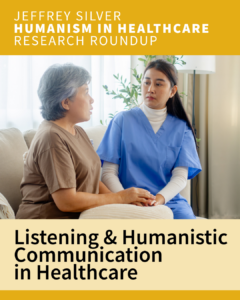
 In the 2025 Dr. Hope Babette Tang Humanism in Healthcare Essay Contest, the three winning nursing students captured moments that define humanistic care: Vonnie Cesar sharing her own experience with gestational diabetes to connect with Joe, a diabetic patient; Christine Nepomuceno sitting beside Mrs. Jones, who is dying, to hold space for her grief; and Roz Agheli asking Mr. L, a heart transplant candidate, about his dreams for the future.
Each essay illuminates the same fundamental truth — that clinical excellence requires more than technical skill. It demands the ability to listen, to connect, and to see the whole person behind the diagnosis. The three nursing student essays noted above illustrate how truly listening transforms patient experiences. This Research Roundup connects the powerful student narratives with two recent research publications on the role of listening in patient care and communication among interprofessional teams.
Measuring the Impact of Humanistic Care: A Six-Item Scale to Enhance Patient Trust. Brainard, C., & Maraccini, A. (2026). Journal of Patient Experience, 13. Access the Free Article
What: Chris Brainard and Amber Maraccini’s 2026 study at UAB Medicine shows how specific, observable clinician behaviors are linked to patient satisfaction. The researchers embedded the Medallia-Gold Humanism Trust Scale into routine post-visit surveys across primary care and family medicine clinics, collecting data from 1,065 patients over two three-month periods in 2023-2024.
The scale assessed patient perception of six clinician behaviors: patiently addressing questions, asking about overall health goals, asking about thoughts and opinions, offering follow-up opportunities, being fully present, and showing genuine concern. Three behaviors emerged as the strongest predictors of patient satisfaction: demonstrating genuine concern (OR=14.5, p<.001), patiently addressing questions (OR=3.9, p=.001), and being fully present during the encounter (OR=2.7, p=.020).
The study’s significance lies in reinforcing the essential role of trust — built by listening and engaging fully — in creating patient satisfaction. As the authors note, their work moves beyond measurement to inform practical, scalable strategies for strengthening humanistic care.
So What: The authors emphasize that behavior-based feedback provides actionable guidance rather than abstract concepts. Even single behaviors, like taking time to address questions or listening while being fully present, produced measurable improvements in patient satisfaction.
The researchers note that clinicians responded more positively to behavior-based feedback than to traditional satisfaction scores, finding it more constructive, actionable, and aligned with their intrinsic motivation to provide compassionate care.
Now What: The authors advocate for integrating behavior-based trust measures into existing feedback systems, shifting from score-based monitoring toward coaching at the point of care. They note that UAB Medicine is expanding this work to examine trust-building across additional specialties to strengthen health outcomes.
The study points toward connecting these humanistic behaviors with clinical outcomes, suggesting future research might examine how trust-building behaviors interact with medication adherence and long-term patient engagement.
These findings about measuring humanistic behaviors connect directly to how such behaviors function in real clinical settings — particularly when multiple professionals must coordinate care. The second study tells us more about the benefits of a healthcare team that comes together at the bedside.
Nurse-Physician Communication During Interdisciplinary Team Rounding: An Observational Study in Internal Medicine. Krishnan, D., Dermenchyan, A., Simon, W., Chen, C., Vangala, S., & Dowling, E. P. (2025). Journal of Multidisciplinary Healthcare, 6643-6651. Access the Free Article
What: Dhwani Krishnan and colleagues’ 2025 observational study at UCLA Health examined 1,007 patient encounters during morning internal medicine rounds. The researchers distinguished between bedside rounding time (BRT), defined as total time physicians spent at the patient’s bedside, and nurse-physician interaction time (RIT), measured by the duration of direct communication between nurses and physicians. These proved to be distinct measures: In nearly one-quarter of cases, RIT exceeded BRT, indicating interactions occurred outside the patient’s room.
Of observed encounters, 64.7% included a nurse-physician interaction, with a mean interaction time of 6.1 minutes. Longer BRT increased the likelihood of discussing hospitalization goals (OR=1.60) and discharge planning (OR=1.25) but showed no association with nurse involvement. In contrast, longer RIT significantly increased the likelihood of nurse involvement and was associated with greater patient and family engagement.
So What: The authors found that approximately one-third of observed bedside rounding events included no nurse-physician interaction at all. They emphasize this represents a critical gap in interdisciplinary communication that may limit essential clinical information exchange, reduce care coordination opportunities, and potentially impact patient safety.
The study revealed that when nurses participated in bedside discussions, patients and families were significantly more likely to engage actively in key conversations about daily plans, hospital stay, and discharge. The authors conclude that nurse-physician interaction duration is a stronger predictor of engagement from both nurses and patients’ families than bedside time alone.
Now What: The authors argue that operational improvement efforts focused solely on increasing physician bedside time may be insufficient. Instead, interventions should prioritize strengthening interdisciplinary communication and enhancing nurses’ roles as patient advocates for daily care needs.
They recommend structured rounding protocols, dedicated time for nurse-physician discussions, and enhanced team training in collaborative communication to address the communication gap. The authors emphasize that any initiative to optimize nurse-physician rounding must be designed to integrate the clinical priorities of both professions.
What This Means for Humanistic Healthcare Education
These studies converge on a powerful truth: Humanistic care isn’t abstract — it can be defined, measured, taught, and cultivated through intentional educational practices. Together, they offer medical and nursing educators insight into developing the next generation of healthcare professionals.
The UAB Medicine trust study demonstrates that we can move beyond vague exhortations to “be more empathetic” and instead provide concrete, behavioral targets: demonstrate genuine concern, patiently address questions, be fully present. Such behaviors are measurable actions with demonstrated impact on patient satisfaction. When we connect this finding to the student essays, we see these behaviors in action: Vonnie’s decision to pull up a chair and truly listen to Joe, Christine’s choice to sit with Mrs. Jones in her grief, Roz’s conversation with Mr. L about what he hoped to do with his new heart. Each represents the operationalization of trust through presence and concern.
The UCLA nurse-physician communication study reveals that creating space for humanistic care requires more than individual clinician intention — it demands structural support for interprofessional collaboration. The finding that one-third of bedside rounds included no nurse-physician interaction represents a systems-level failure. When nurses participate, patients and families participate. For educators, this suggests that teaching humanistic care cannot focus solely on individual clinician behaviors. Instead, we must also teach students how to create and protect time for meaningful interprofessional dialogue, even in time-pressured environments.
Between these studies, several practical implications emerge for healthcare education:
First, integrate observable trust behaviors into clinical skills training from day one. Rather than waiting until students reach the wards to discuss humanistic care, use the Medallia-Gold Trust Scale behaviors as a framework for teaching clinical communication in preclinical years. This could look like role-play scenarios where students practice demonstrating genuine concern, being fully present, and patiently addressing questions and faculty provide specific feedback on these behaviors just as they would on physical examination technique.
Second, design clinical experiences that require interprofessional collaboration. The UCLA study makes clear that proximity isn’t enough, but that nurses and physicians need structured time for genuine interaction. In clinical rotations, educators could expect that students will seek out their colleagues’ perspectives on patient care plans, participate in interprofessional rounds, and explicitly reflect on what they learned from their colleagues. Nurse-physician interaction can be a competency to be developed.
Third, recognize that teaching humanistic care requires attention to both content and context. The trust behaviors are the content, the specific things clinicians do, and the interprofessional communication structures are the context, the systems and time allocations that make humanistic behaviors possible. Stories are the bridge, showing how real clinicians navigate the tension between what they want to do (provide humanistic care) and what circumstances allow them to do.
Finally, remember that measurement drives improvement, but only if we measure the right things. For educators, this suggests that our assessment systems should similarly evolve — moving from vague evaluations of “professionalism” toward specific, observable indicators of humanistic practice.
The three essays that inspired this Research Roundup, Vonnie’s story of sharing gestational diabetes with Joe, Christine’s bedside vigil with Mrs. Jones, Roz’s conversation about dancing with Mr. L, provide the human face for these research findings. They remind us why this work matters, because on the other side of every data point, every odds ratio, every conceptual framework is a patient who needs to be seen, heard, and cared for as a whole person. These students are getting it right. Our challenge as educators, researchers, and administrators is to create the conditions that help every student develop and maintain that kind of humanistic practice throughout their careers.
To receive email notification of new studies once per month, enter your information here and select “Jeffrey Silver Research Roundup” from the checkboxes at the bottom. See previous posts in this series.