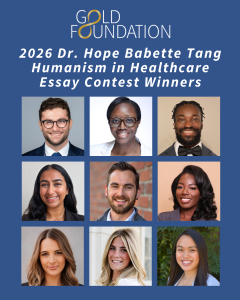
Five medical student teams in Kansas, Michigan, Puerto Rico, Illinois, and North Carolina undertake research and service projects to support community health
The Arnold P. Gold Foundation is delighted to announce five 2026 Gold Student Summer Fellowship projects, which include developing one-on-one electronic medical record (EMR) support for older adults, a new religious identity safety in healthcare measurement, a website and chatbot to support families of preschoolers with developmental delays and disabilities, a church-based, café-modeled chronic care initiative, and an emotional survival kit for parents with babies in the NICU.
The 2026 teams are made up of a total of 21 students from five medical schools: Kansas City University College of Osteopathic Medicine – Joplin, Oakland University William Beaumont School of Medicine, San Juan Bautista School of Medicine, University of Chicago Pritzker School of Medicine, and University of North Carolina School of Medicine.
Gold Student Summer Fellowships provide opportunities each year for medical students to undertake a research or service project related to community health and to develop skills to become humanistic, relationship-centered physicians. Many teams will also be using a Gold Foundation tool in their work.
“This year’s Fellows are pursuing projects that reach across a wide range of populations, needs, and sensitive topics — the kinds of issues that require courage, humility, and deep listening,” said Louisa Tvito, MSW, Vice President of Programs. “Every project is rooted in rigorous assessment and the development of essential community partnerships that support long-term, sustainable impact. As Gold Student Summer Fellows, these medical students are not only designing projects; they are shaping the future of healthcare leadership.”
The Gold Foundation is grateful to the Mellam Family Foundation for its continued support of this program.
Meet this year’s 2026 Gold Student Summer Fellows and their projects:
Bridging the Digital Divide: Empowering Older Adults Through EMR Access
Nithya Gurumurthy, MS1 | Annette Varghese, MS1
University of North Carolina School of Medicine

From left: Nithya Gurumurthy and Annette Varghese
As healthcare systems increasingly rely on electronic medical records (EMRs) and patient portals, access to care is becoming defined by digital literacy. Adults over age 65 account for nearly 40 percent of healthcare spending in the United States, yet only about 40% of adults in this age group use the internet to access their EMR. This barrier can reduce patients’ understanding and engagement in their care and limit their connection with their care team.
In partnership with Dr. Maureen Dale, a geriatrician at UNC Health, and the Seymour Center in Chapel Hill, this project will implement one-on-one EMR health literacy sessions for older adults and their caregivers. Participants will receive support navigating patient portals, requesting medication refills, and understanding visit summaries. This Gold Student Summer Fellowship project is designed to empower patients, strengthen trust, and narrow the digital divide between generations.
Operationalizing Religious Identity Safety in Healthcare: Development and Pilot of a Trauma-Informed Religious Identity Safety Index (RISI)
Wanees Hannan, M2 | Hannah Knoll, M2 | Nabeeha Shakil-Ahmad, M2 | Ava Ghorbani, M2
Oakland University William Beaumont School of Medicine

From left: Wanees Hannan, Hannah Knoll, Nabeeha Shakil-Ahmad, Ava Ghorbani
Religious identity is a core dimension of personhood that shapes health beliefs, trust in clinicians, and engagement with care. Some patients who are members of a minority religious faith report experiences of bias, identity concealment, accommodation failures, and mistrust in healthcare settings, yet few healthcare systems measure religious identity safety as a component of humanistic care.
This interfaith, interprofessional project will develop and pilot the Religious Identity Safety Index (RISI), a trauma-informed instrument designed to assess perceived religious identity safety in healthcare encounters. Over three phases, this project will include: listening sessions with Jewish and Muslim patients, faith leaders, and community representatives; development and pilot administration of a 10–15 item RISI tool; implementation of a systems-level micro-intervention, including a clinician communication guide, and reassessment of RISI scores.
This Gold Student Summer Fellowship project is designed to advance systems transformation by centering patient-defined safety and trust as measurable indicators of humanistic care.
From Navigator to Platform: Website-Paired Large Language Model to Support Families of Preschoolers with Developmental Delays and Disabilities
Mariam Hassan, MS1
University of Chicago Pritzker School of Medicine

Mariam Hassan
Families from historically marginalized communities — particularly Black, Latino/a, and low-income families — are disproportionately less likely to receive mandated school-based services. In partnership with Preschool and Me, a patient-navigator service developed at the University of Illinois Chicago for children with developmental delays or disabilities, this project seeks to expand caregiver-centered support by leveraging technology to provide 24/7 support.
Building on the patient-navigator model, this initiative will develop a website paired with a large language model (LLM) chatbot designed to guide families through the Individualized Education Program (IEP) process. The platform will provide parent support, accessible information, and navigation strategies while modeling empathy, validation, and self-advocacy. This Gold Student Summer Fellowship project aims to reduce disparities in access to developmental services and empower families as partners in care.
Cuidar en Comunidad: A Church-Based, Café–Modeled Chronic Care Initiative in Puerto Rico
Natalia Maverakis Ramirez, MS3 | Eliomar Rosa Ramón, MS3 | Melvin Arroyo Flores, MS3 | Yandy García Martín, MS3 | Marian Lakey, MS3 | Jorge Figueroa Quintana, MS3 | Andrea Figueroa Grillasca, MS3 | Lourdes Ponte Cordova, MS3 | Delia Ocaña Narváez, MS4 | Gabriela Ehringer Muñoz, MS3 | José Rodríguez Ocasio, MS4 | Brittany Herrera Contreras MS3 | Mileny Cedeño Landi MS3
San Juan Bautista School of Medicine

Top row, from left: Natalia Maverakis Ramirez, Eliomar Rosa Ramón, Melvin Arroyo Flores, Yandy García Martín, Marian Lakey. Middle row, from left: Jorge Figueroa Quintana, Andrea Figueroa Grillasca, Lourdes Ponte Cordova, Delia Ocaña Narváez, Gabriela Ehringer Muñoz. Bottom row, from left: José Rodríguez Ocasio, Brittany Herrera Contreras, Mileny Cedeño Landi.
Hypertension and diabetes are leading contributors to disability and premature mortality in Puerto Rico, compounded by barriers such as limited health literacy, fragmented access to care, food insecurity, and ongoing economic stressors. Cuidar en Comunidad is a church-based chronic disease support initiative designed to address these challenges through culturally grounded education and peer support.
Partnering with a community church, a team of 13 medical students will facilitate CARE Café–modeled gatherings—structured, dialogue-based conversations that center dignity, storytelling, and shared problem-solving. Participants will attend weekly sessions focused on understanding diagnoses, medications, and care plans while receiving support navigating healthcare systems
By embedding care in a trusted faith-based setting, this Gold Student Summer Fellowship seeks to increase social support, enhance self-management confidence, and foster stronger relationships between community members and healthcare professionals.
Holding On: Emotional Support for Parents During the NICU Journey
Ritika Sadalge, OMS-II
Kansas City University – Joplin Campus

Ritika Sadalge
Admission to the Neonatal Intensive Care Unit (NICU) is often sudden and emotionally overwhelming for parents, whose psychological needs may be addressed only indirectly during critical medical care. This project will create a self-guided Emotional Survival Toolkit to support parental emotional regulation and reinforce parental identity during NICU hospitalization.
Developed in partnership with Ronald McDonald House Charities of the Four States in Joplin, Missouri, the toolkit will include a brief booklet normalizing emotional responses, grounding exercises, reflection prompts, and affirmation cards. Optional materials will help families honor meaningful moments, such as first holding or discharge, with a dedicated section addressing unexpected or preterm delivery. The toolkit will be designed to be low-burden and easily reproducible. This Gold Student Summer Fellowship project aims to promote resilience, strengthen parent–infant bonding, and integrate holistic, humanistic support into existing family-centered care environments.